
Industrial IoT deployments fail in predictable ways.
Not because the router was the wrong model. Not because the SIM was on the wrong network. But because the antenna layer was treated as an afterthought – a coil of plastic and copper bolted on at the end of the spec sheet.
By then, the performance ceiling has already been set. The physics does not care about the dashboard.
At Fullband, we build IoT antennas for engineers and system integrators who understand that reliable cellular connectivity starts at the RF interface – not the firmware update. This guide covers what an IoT antenna actually is, why frequency coverage determines long-term viability, and how to specify the right antenna system the first time.
An IoT antenna is a purpose-engineered RF component designed to support machine-to-machine and industrial connectivity across one or more frequency bands. It is the physical interface between a cellular modem or wireless module and the radio access network.
That distinction matters. Unlike a consumer antenna bolted to a domestic router, an industrial IoT antenna must deliver consistent performance across years of continuous operation in environments that are hot, cold, vibration-heavy and electromagnetically hostile.
The specific requirements are:
In a properly designed IoT system, three components must all be specified to the same standard: the industrial router, the IoT SIM, and the antenna system. The router processes the data. The SIM authenticates on the network. The antenna does something neither of the others can – it interacts directly with RF energy.
Specifying an IoT antenna requires understanding which frequencies the deployment will actually use – today, and over the lifetime of the installation.
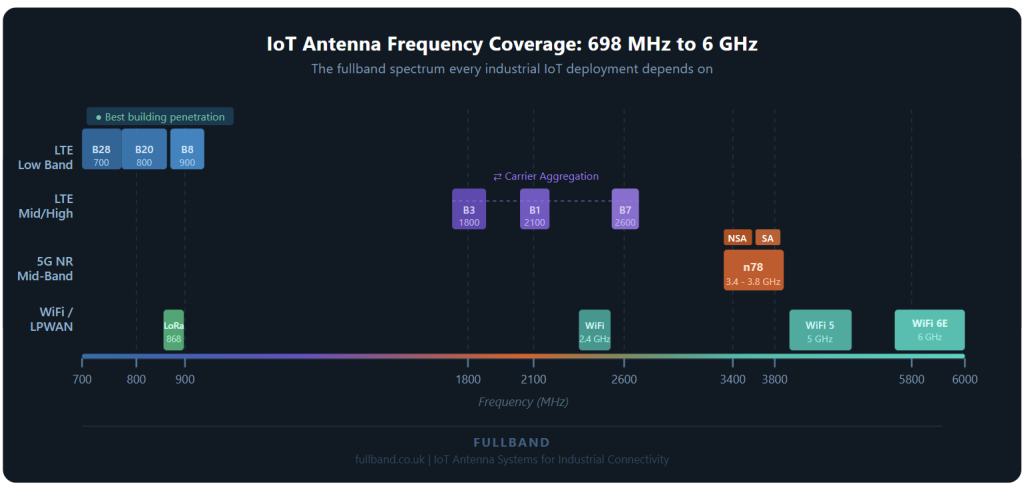
In the UK and across Europe, LTE operates across a wide range of bands. The most commonly deployed include:
700 MHz, 800 MHz and 900 MHz in the low band, which provide extended range and superior penetration through concrete, brick and steel structures. These are the bands that keep an installation online when signal conditions are difficult.
1800 MHz, 2100 MHz and 2600 MHz in the mid and high bands, which carry the bulk of network capacity in dense areas.
An IoT antenna must support all of these efficiently if the modem is to take full advantage of carrier aggregation – the process by which a 4G modem combines multiple LTE bands to increase throughput and stability.
5G introduces two distinct architecture modes, both of which affect antenna requirements.
5G NSA (Non-Standalone) uses a 4G LTE core but adds a 5G NR layer on top. In the UK, this typically means combining low-band LTE with 3.4-3.8 GHz mid-band 5G. The antenna must support both layers simultaneously, which means coverage from sub-700 MHz through to at least 3.8 GHz.
5G SA (Standalone) uses a fully independent 5G core and is being progressively deployed by UK operators. Mid-band 5G at 3.4-3.8 GHz carries the primary capacity load, with lower bands providing coverage depth.
A fullband IoT antenna covering 698 MHz to 6 GHz protects investment through both current deployments and future spectrum changes. A narrowband LTE-only antenna does not.
Industrial IoT edge computing increasingly places cellular modems, WiFi access points and GNSS modules inside a single enclosure. WiFi operates across 2.4 GHz, 5 GHz and – with WiFi 6E and WiFi 7 – into 6 GHz spectrum.
An IoT antenna system that covers up to 6 GHz supports cellular, dual-band WiFi and emerging 6 GHz WiFi from a single wideband element or correctly integrated multi-port antenna, reducing installation complexity and improving RF separation between modules.
Not every IoT deployment runs on cellular. LoRaWAN operates at 868 MHz in the UK and is widely used for low-power sensor networks across utilities, smart metering and environmental monitoring. NB-IoT and LTE-M operate within LTE spectrum allocations but have their own link budget characteristics.
LoRaWAN antenna performance at 868 MHz requires specific tuning. A cellular antenna that covers 700-800 MHz is not automatically a well-matched LoRaWAN antenna. The resonant point matters. When specifying a mixed-technology installation, each radio interface needs a correctly tuned antenna – or a multi-band design that genuinely covers 868 MHz with low VSWR, not just proximity to the band.
The single most important factor for indoor and shielded IoT installations is building penetration – and building penetration is governed by frequency.
Lower frequencies travel further and penetrate dense materials with less attenuation. 700 MHz 5G penetrates a reinforced concrete wall more effectively than 3.5 GHz mid-band. 800 MHz LTE outperforms 2600 MHz in industrial plant rooms, lift shafts, underground parking structures and utility cabinets.
This has a direct implication for antenna specification. If an IoT antenna does not support low-band frequencies efficiently – with genuine gain, not just nominal coverage – then indoor installations are dependent on whatever high-band signal leaks through. That is a fragile foundation for a deployment that needs to run unattended for five years.
The antenna must support the bands the modem will actually use in difficult conditions, not just the bands visible on a sunny day with direct line of sight to the cell tower.
The metrics that describe cellular connection quality are directly influenced by the antenna layer:
When these metrics are poor – driven by an undersized or mismatched antenna – the symptoms are predictable. VPN tunnels become unstable. Packet retries increase. Watchdog timers trigger unnecessary reboots. Latency spikes at random intervals. The deployment looks unreliable when the underlying problem is a two-metre run of RG58 terminated in a rubber duck.
The antenna is not primarily about download speed. It is about RF stability under sustained load.
LTE Cat 4 and above uses 2×2 MIMO as standard. LTE Advanced Pro and 5G NR use 4×4 MIMO in many configurations. MIMO – multiple-input, multiple-output – depends on the antenna layer delivering spatial diversity: multiple independent signal paths that allow the modem to combine signals and reject interference.
For MIMO to function correctly, the antenna elements must be:
An antenna system that does not meet these requirements does not disable MIMO – it degrades it. The modem still attempts to use multiple streams, but the performance gain disappears because the signals are too similar for the spatial processing to be effective.
When evaluating IoT antennas for MIMO deployments, port isolation figures matter. So does the consistency of gain across both ports. A pair of single-port antennas from different product lines, used together because they share the same connector, is not a MIMO antenna system.
The deployment environment determines antenna type before any other specification begins.
Indoor antennas are appropriate when signal levels at the installation point are already strong, the enclosure is not fully metallic, and the environment is controlled. Low-profile dome antennas and magnetic-mount units work well in these conditions. They are not appropriate as a default choice for cost reasons.
Outdoor antennas are required whenever the IoT device is installed inside a metal cabinet, in a location with marginal coverage, or in an environment with significant attenuation between the device and the network. Moving the RF interface outside the enclosure – even by a metre – typically produces an immediate and measurable improvement in SINR.
For permanent industrial installations, outdoor rated antennas with IP67 or higher sealing, UV-stable housings and appropriate mounting options are the correct baseline specification, not an upgrade tier.
Antenna gain figures are measured at the connector. What happens between the connector and the modem port determines whether that gain is useful or theoretical.
At frequencies above 2 GHz, cable loss increases significantly. At 3.5 GHz – the core 5G mid-band frequency in the UK – basic coaxial cable loses signal at a rate that can negate an antenna’s gain advantage over short runs. At higher frequencies the situation is worse.
An IoT antenna system must be specified as a complete RF chain:
Quoting antenna gain without specifying cable type and run length is not a complete specification. A 5 dBi antenna on three metres of unsuitable coax can easily perform worse than a 3 dBi antenna on a short, low-loss cable run.
Industrial IoT installations are not consumer devices. They are expected to operate continuously for five to ten years with minimal intervention. Antenna specification should reflect that timeline.
A robust IoT antenna specification covers:
Treating the antenna as a line item to be value-engineered at the end of a project is the most reliable way to ensure a site revisit within twelve months.
What is the difference between an IoT antenna and a standard cellular antenna? An IoT antenna is designed for sustained, unattended operation in industrial environments. It typically covers a wider frequency range, is built to higher IP ratings, supports MIMO configurations, and is specified for long-term stability rather than peak performance in controlled conditions.
Do I need a different antenna for 4G and 5G? Not if the antenna is specified correctly from the start. A fullband antenna covering 698 MHz to 6 GHz supports LTE, 5G NSA and 5G SA simultaneously. A 4G-only antenna will not support 5G mid-band at 3.4-3.8 GHz.
Can I use a cellular IoT antenna for LoRaWAN? Only if the antenna is genuinely tuned for 868 MHz with low VSWR at that frequency. Proximity to a band on a frequency chart does not mean an antenna is well-matched at that frequency. For LoRaWAN deployments, verify the VSWR figure at 868 MHz specifically.
Why does my IoT router keep rebooting or dropping VPN sessions? In many cases, the root cause is poor RF signal quality rather than a router or SIM issue. Check RSRP, RSRQ and SINR values via the router’s diagnostic interface. If SINR is below 10 dB or RSRP is below -100 dBm, the antenna system should be the first thing reviewed.
What does fullband mean in the context of IoT antennas? Fullband refers to wideband frequency coverage from the lowest LTE bands (around 700 MHz) through to 6 GHz, encompassing LTE, 5G mid-band and WiFi spectrum in a single antenna design. It avoids the need to specify and install separate antennas for each technology or frequency band.
How much does cable loss affect IoT antenna performance at 5G frequencies? Significantly. Standard RG58 coax loses approximately 1 dB per metre at 3.5 GHz. A three-metre run can erase the gain advantage of a quality external antenna entirely. Low-loss cable such as LMR-200 or equivalent is required for 5G mid-band installations with any meaningful cable run.
Is an outdoor IoT antenna always better than an indoor one? In any installation where the device is inside a metal enclosure or in a location with significant attenuation, yes. Moving the RF interface outside the shielding is the single most effective intervention available. For installations where signal is already strong and the enclosure is non-metallic, a quality indoor antenna can be adequate.
Every IoT deployment has a performance ceiling set by three factors: available network coverage, environmental attenuation, and the efficiency of the antenna system.
The router operates within that ceiling. The SIM operates within that ceiling. The antenna defines it.
That is why the antenna is not a commodity component to be sourced on price. It is the most physically exposed element in the system, often the last to be specified, and the one that determines whether everything else performs to its potential.
Fullband Antennas exists because the UK IoT market has spent too long accepting cheap, narrowband antennas on premium industrial installations. We build and supply Fullband IoT antennas for deployments where reliability is not optional.
If you are specifying an IoT antenna system and want to discuss the requirements, contact the Fullband team.
Published by Fullband – IoT Antenna Systems for Industrial Connectivity. Based in the UK.